
Cost-Effective Hybrid Solar Installation: How to Get Backup Power Without Overspending
A hybrid solar system can reduce electricity dependence while providing battery backup during power cuts. The key to making hybrid solar installation cost-effective is not simply choosing the cheapest system—it is designing the right solar capacity, battery size and backup load for your actual needs.
Spend smarter on solar backup
Is a hybrid solar system cost-effective?
A hybrid solar system usually costs more upfront than a standard on-grid system because it includes battery storage and additional backup-control equipment. However, it can deliver better overall value for homes and businesses that need both electricity savings and dependable backup.
The most cost-effective hybrid installation is usually a properly sized system. Instead of buying a large battery to operate every appliance during a power cut, many properties can reduce investment by backing up only essential loads such as lights, fans, Wi-Fi, refrigerators, CCTV, computers and selected equipment.
Understand the investment
Why does hybrid solar installation cost more?
Battery storage
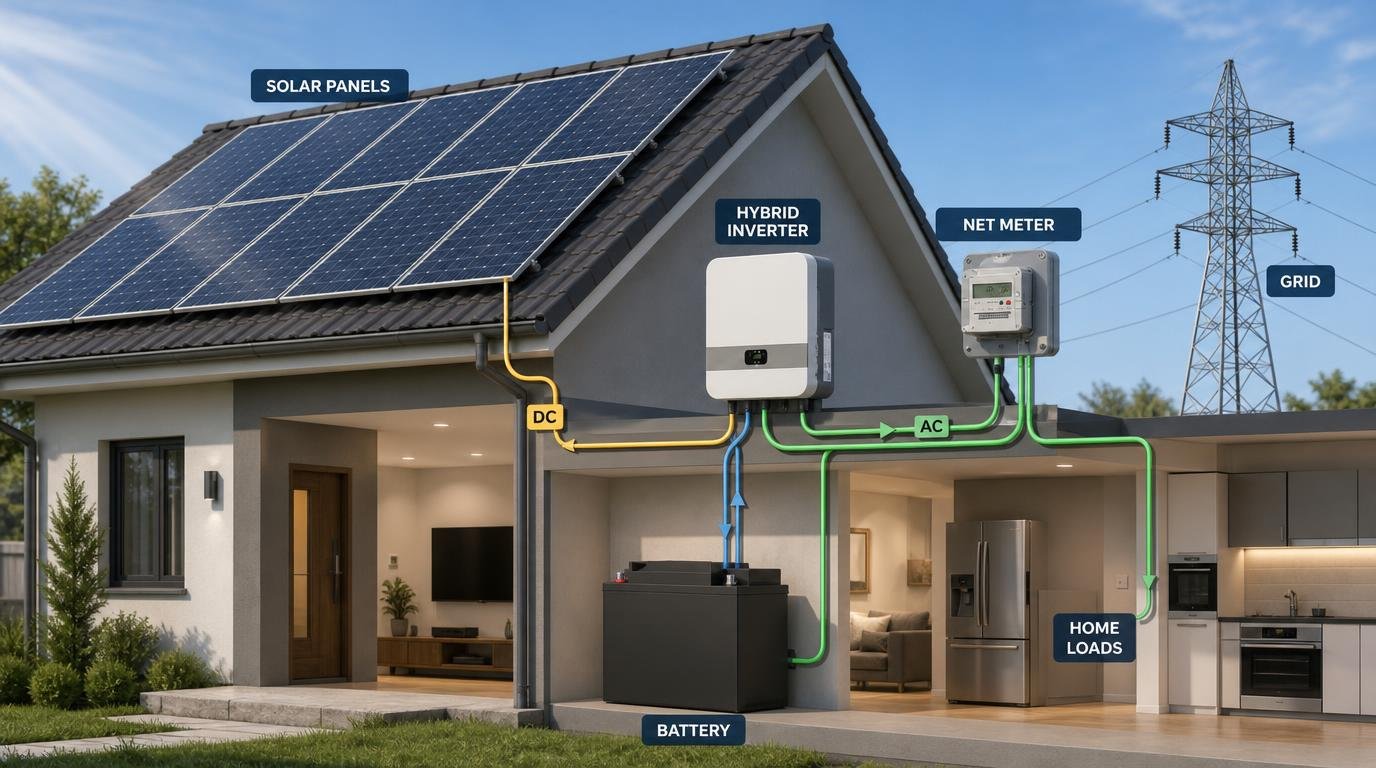
The battery is one of the largest additional costs in a hybrid system. Capacity, usable energy, chemistry, warranty and power output all influence pricing.
Hybrid inverter
A hybrid inverter manages solar generation, battery charging, grid supply and backup output. It is more sophisticated than a basic grid-connected inverter.
Backup electrical work
Essential circuits may need to be separated so that selected loads continue running safely during an outage without unnecessarily increasing battery demand.
Five ways to control investment
How to make hybrid solar installation more cost-effective
Back up only essential loads
Do not automatically design the battery for the entire property. Separating essential circuits can significantly reduce the inverter power and battery capacity needed.
Use solar directly during daytime
Solar energy used immediately by the property avoids unnecessary battery cycling and helps you get maximum value from the panels during daylight hours.
Size the battery for real backup hours
If most outages are short, designing for many hours of backup may add cost without delivering proportional value. Select the backup duration you genuinely need.
Plan for future expansion
A compatible inverter and well-planned electrical design may allow battery or solar expansion later, helping you avoid buying maximum capacity on day one.
Match solar, inverter and battery correctly
Oversizing one component while undersizing another can waste money. The system should be engineered as one coordinated energy solution.
Choose quality with service support
Good warranties, monitoring and local technical support can reduce the risk of unexpected repair or replacement costs during the system lifetime.
The biggest cost-saving decision
Smart battery sizing can reduce hybrid solar cost
Battery capacity should be based on the appliances you want to run during a power cut and how long you need them to operate. Buying more battery capacity than necessary increases upfront cost and may extend the financial payback period.
- List all appliances that genuinely need backup
- Record their running wattage and starting power where relevant
- Decide the required backup duration
- Allow for inverter losses and battery reserve
- Check the battery's usable capacity—not only its advertised capacity
Choose according to your priority
On-grid vs hybrid vs off-grid: which is more cost-effective?
| Priority | On-Grid Solar | Hybrid Solar | Off-Grid Solar |
|---|---|---|---|
| Lowest initial investment | Best fit | Higher | Usually higher |
| Electricity bill reduction | Strong | Strong when properly designed | Depends on load and storage |
| Backup during power cuts | No in a standard system | Yes, for designed backup loads | Yes |
| Battery required | No | Yes for useful backup | Yes |
| Best suited for | Reliable-grid locations focused mainly on bill savings | Properties wanting savings plus backup | Remote or grid-independent properties |
Actual performance and economics depend on consumption pattern, system size, grid rules, equipment selection, installation quality and battery usage.
When paying more upfront makes sense
Where hybrid solar can deliver better overall value
Homes with frequent power interruptions
If outages regularly affect comfort, refrigeration, internet, security or work-from-home activities, battery backup can add practical value beyond electricity savings.
Businesses that cannot afford downtime
Keeping routers, billing systems, CCTV, computers, communication equipment or selected production loads active can reduce disruption during short outages.
Properties with high daytime solar use
Using solar power directly during the day improves system utilisation and reduces dependence on stored or grid electricity.
Owners planning long-term energy resilience
A hybrid-ready design can provide a structured path to additional storage or energy management upgrades in the future.
For larger commercial or institutional properties, a professional energy audit can identify which circuits are most important and help avoid unnecessary battery capacity.
Protect your budget
Five mistakes that make hybrid solar unnecessarily expensive
Trying to back up every appliance
Large air conditioners, water heaters, pumps and other heavy loads can dramatically increase inverter and battery requirements. Prioritise essential loads unless whole-property backup is genuinely required.
Choosing battery size by guesswork
Battery sizing should be calculated using actual power demand and desired backup time—not simply selected from a standard package.
Comparing only the total quotation price
Compare panel capacity, inverter output, usable battery capacity, warranties, protection equipment, monitoring, installation scope and after-sales support.
Ignoring future loads
New air conditioners, home offices, EV charging or business equipment can change your electricity profile. A system designed without future demand may require costly changes later.
Using incompatible components
The inverter, battery and control system must be compatible. Proper integration is essential for safe charging, backup operation, monitoring and warranty support.

Design before buying
A cost-effective hybrid installation starts with an energy assessment
Before selecting panels, batteries or an inverter, the installer should understand your electricity consumption, power-cut pattern and backup priorities.
- Review recent electricity bills
- Measure or estimate important loads
- Identify essential backup circuits
- Define expected backup duration
- Check roof area, shade and structure
- Select safe inverter and battery locations
- Confirm applicable grid and metering requirements
- Prepare a transparent quotation with inclusions and exclusions
Learn more about the complete hybrid solar system and B&B Green Energy’s solar installation process.
Think in lifecycle value
How should you compare hybrid solar quotations?
Solar generation capacity
Check panel wattage, number of modules, mounting structure, expected generation conditions and product warranty.
Usable battery capacity
Do not compare batteries only by nominal kWh. Ask how much energy is actually usable and what operating reserve is recommended.
Backup power rating
Confirm how much continuous and surge power the inverter can supply to essential loads during an outage.
Warranty and service
Compare panel, inverter, battery and workmanship warranties, plus the process for technical support and warranty claims.
Electrical protection
Confirm that isolators, surge protection, earthing and all necessary backup switching or circuit separation are included.
Monitoring
A monitoring platform helps you track solar production, load consumption, battery state of charge and grid interaction.
Local solar planning
Hybrid solar, grid connection and net metering in Kerala
A hybrid system can be designed to use solar, battery storage and the electricity grid together. Where the configuration and applicable utility rules permit, surplus grid-connected solar generation may be exported through an approved metering arrangement.
If you are planning a grid-connected hybrid system, confirm the latest requirements before installation. Read B&B Green Energy’s KSEB net-metering guide and speak with the installation team about the current approval process.
Residential customers considering available rooftop-solar support should also review the current eligibility and technical requirements before assuming that every component of a hybrid system qualifies for financial assistance.

Expert Solar Consultation
Meet C. A. Biju — Energy Consultant
15 Years of Experience in Solar System Designing
With 15 years of experience in solar system designing, C. A. Biju focuses on developing practical and cost-effective solar solutions based on each customer’s actual energy requirements.
Every property has different electricity usage, backup requirements and future energy needs. His approach is to understand the customer’s requirements first and then design the solar capacity, inverter and battery configuration accordingly.
- Solar system design based on customer requirements
- Assessment of electricity consumption and usage patterns
- Smart sizing of solar panels, inverter and battery storage
- Essential-load planning for cost-effective hybrid backup
- Solutions designed to balance investment, savings and reliability
Build the right system—not the biggest system
Get a cost-effective hybrid solar design for your property
Share your recent electricity bills, essential backup loads and expected backup hours with B&B Green Energy. Our team can assess the property and recommend a hybrid solar configuration focused on energy savings, reliable backup and sensible investment.
Frequently asked questions
Cost-effective hybrid solar installation FAQs
Is hybrid solar cheaper than on-grid solar?
No. Hybrid solar normally has a higher upfront cost because it includes battery storage and backup-control equipment. It can provide better value where backup power is important.
How can I reduce hybrid solar installation cost?
Back up only essential loads, select a battery based on actual backup hours, use solar directly during the day, avoid unnecessary oversizing and choose compatible equipment with suitable warranties.
Do I need a large battery for a hybrid solar system?
Not necessarily. Battery capacity should match the essential load and required backup duration. Many homes can reduce cost by separating important circuits instead of designing for whole-home backup.
Can I add more battery storage later?
Some systems support future battery expansion, but this depends on the inverter, battery platform and original design. If expansion is likely, discuss it before purchasing the system.
Will a hybrid solar system reduce my electricity bill?
It can reduce grid electricity consumption by using solar power directly and, depending on system settings, using stored solar energy later. Actual savings depend on consumption, solar generation, battery cycling and grid arrangements.
What should I compare before choosing a hybrid solar installer?
Compare solar capacity, usable battery capacity, inverter power, backup load design, protection equipment, warranties, monitoring, installation quality and after-sales support—not only the total quoted price.
Which system is best if I only want the lowest solar cost?
If your grid supply is reliable and your main objective is electricity-bill reduction, a standard on-grid solar system is usually simpler and less expensive. Hybrid solar is more suitable when backup power is also an important requirement.